Nutrition
Your Old Diet Stopped Working. Welcome to Peri-Menopause.
During peri-menopause, estrogen decline changes how your body handles protein, blood sugar, and fat storage. Here's what actually needs to change on your plate, and how a personal chef makes the shift sustainable every night of the week.

Key Takeaways
- During peri-menopause, estrogen decline changes how your body handles protein, blood sugar, and fat storage
- Here's what actually needs to change on your plate, and how a personal chef makes the shift sustainable every night of the week
You haven't changed what you eat. You haven't gotten lazier at the gym. And yet the scale, the mirror, your energy at 3pm, and your sleep are all quietly getting worse.
This is not a willpower problem. Your body, starting somewhere in your late 30s or early 40s, is running different software.
During peri-menopause, estrogen levels begin to swing and decline. That single shift changes how your body processes protein, stores fat, regulates blood sugar, and repairs itself overnight. The diet that worked in your 20s and 30s stops working in your 40s for a simple reason: it was never built for this version of you.
The good news is that the fix is knowable and specific. The harder news is that it requires a real change in how dinner actually happens, not just what you theoretically believe about food.
Why your metabolism feels different
The single biggest change during peri-menopause is anabolic resistance. Your body becomes less efficient at converting dietary protein into muscle. Muscle is your metabolic engine. Less muscle means slower metabolism, poorer blood sugar control, and more of what you eat ending up as fat instead of energy.
This is why the same salad-and-grilled-chicken dinner that kept you lean at 34 no longer moves the needle at 44. Your body didn't betray you. Your requirements changed.
Dr. Stacy Sims, one of the leading researchers in women's health, now recommends that peri-menopausal women raise their protein intake to roughly 1 to 1.2 grams per pound of bodyweight per day, with 35 to 40 grams at every meal. For a 150-pound woman, that's 150+ grams of protein, every single day. Most women we talk to are getting about half that.
The four things that actually need to change
If you strip away the noise, the peri-menopause plate has four non-negotiable shifts.
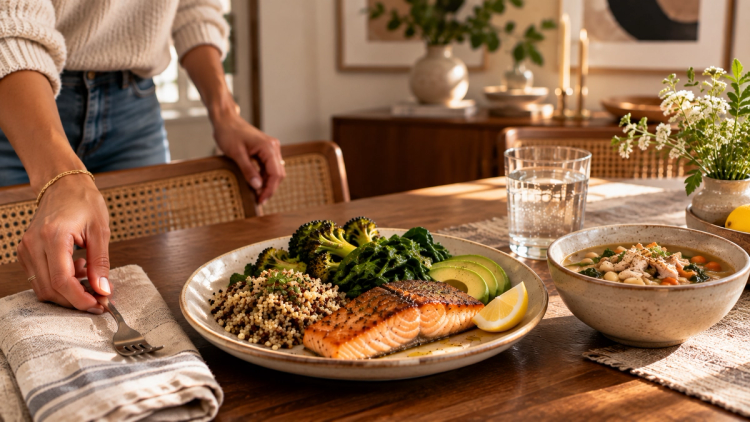
- More protein, every meal. Not a tuna salad for lunch and a big steak for dinner, but evenly distributed, 30 to 40 grams per meal. This single change does more for body composition during peri-menopause than any other dietary intervention.
- Blood sugar stability. Estrogen helps regulate insulin sensitivity. When it drops, you swing higher and crash lower. Meals built around protein, fiber, and fat, instead of pasta-forward or bread-forward plates, keep that curve flat.
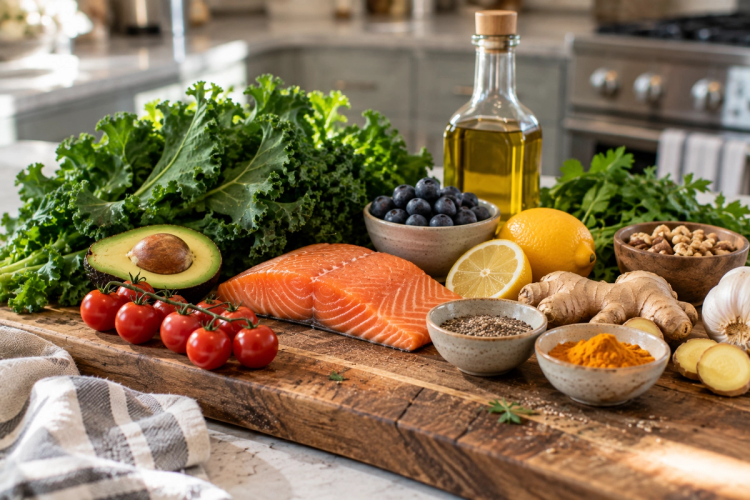
- Anti-inflammatory fats, real ones. Olive oil, avocado, fatty fish, nuts, seeds. Not seed-oil-fried takeout. When your inflammatory baseline is already rising, this matters more than it ever has.
- Consistent meal timing, with most calories earlier. Eating late, past 8pm, compounds the sleep disruption peri-menopause is already causing. Getting most of your protein in by 7pm isn't a diet rule. It's a sleep intervention.
None of this is dramatic. None of it requires a new diet name. What it requires is executing consistently, every day, for years. Which is where it falls apart.